Logos, descriptions, bios, screenshots and facts about Open Kannada and its first project, the kannadi editor. Use them as they are, with no need to ask.
Tagline and story
Kannada should be as easy to use on a computer as English.
Kannada is my mother tongue. About 44 million people speak it, but many everyday tasks on a computer are still harder in Kannada than in English.
In the 2000s, government offices typed 1000s of documents in Nudi and Baraha fonts, and search engines can't read them today. Many free fonts draw ottaksharas, Kannada's stacked letters, incorrectly. The spell checker on most computers dates from 2009. AI models are trained mostly on internet text, which has little Kannada, and the same sentence takes up to 8 times as many tokens in Kannada as in English.
Each of these problems can be fixed, and most have had very few people working on them.
Open Kannada is free, open-source software that fixes them one at a time. We test every tool on real Kannada text, publish the results, and send our fixes back to the fonts and programs people already use, so everyone benefits, not only our own users.
Neha and I started it together, and it needs more people. If you read, write, type or build in Kannada, you can help.
Logos
Open ka is the mark of Open Kannada. The mirror is the mark of kannadi, its editor and library. Each comes as SVG and as a 1024 px PNG, for light and dark backgrounds.
The letters are Noto Sans Kannada, under the SIL Open Font License. Please keep the marks as they are: no new colors, outlines or effects. The names and logos page says how to use them, and the screenshots and text here are CC BY 4.0.
Colors
Indigo#4441be The tile in light mode, links and buttons
Periwinkle#96a2fc The tile in dark mode
Ink#111622 Text in light mode
Paper#f3f6fa The page in light mode
Night#0c0e15 The page in dark mode
Descriptions
In 25 words
Open Kannada makes free, open-source tools for Kannada on computers. Its first, kannadi, converts documents typed in old Kannada fonts to Unicode in the browser.
In 50 words
Open Kannada makes free, open-source software for Kannada. Its first project, kannadi, converts documents typed in 6 old Kannada fonts, including Nudi, Baraha and Akruti, to Unicode. The editor runs in the browser, so files stay on the device. It also types Kannada from English letters.
In 100 words
Open Kannada makes free, open-source software so that Kannada works properly on computers. Government orders, budgets and newspapers from the 2000s were typed in Nudi, Baraha and other fonts that store glyph codes in place of letters, so they cannot be searched or read aloud. Its first project, kannadi, converts 6 of these fonts to Unicode, as a Rust library, a command-line tool and an editor that runs in the browser with no upload. Each conversion is measured on real documents. Open Kannada also tests Kannada fonts and adds checks to shared tools, such as Google Fonts' shaperglot.
Founding members
PRASAD: photo of Prasad Subrahmanya, from Prasad.
Prasad Subrahmanya
Founding member
Prasad Subrahmanya builds Open Kannada's software. He is the founder and CEO of Luminik. Before that, he was CTO of Aura at Bain's Founder's Studio, where he took a workforce-analytics platform from concept to $3.6M ARR in 15 months, and co-founder and CTO of Mainteny. He is based in Oslo, Norway.
kannadi converts text typed in 6 legacy Kannada fonts to Unicode: Nudi, Baraha, Nudi B-Akshara, Kan-Eng, Akruti and Shree-Lipi. kannadi README
On the benchmark corpus of 207 lines from 31 Karnataka government pages of 2002, all 207 Nudi and Baraha lines match the reviewed output of the converter, and 1 line is flagged. A Kannada reader's check of 100 lines is in progress. Measured results
Unicode back to Nudi: 9,029 of 9,047 words from Karnataka government pages of 2002 encode to the exact bytes that were typed. Measured results
Akruti: 908,075 glyphs from 33 Karnataka Acts and Ordinances and 2 budget papers, with 6 unknown glyphs and 22 malformed syllables, each read against the page. Akruti notes
Shree-Lipi: 233,346 glyphs from 173 Udayavani newspaper pages of 2003 and 2004, with 0 unknown glyphs and 20 malformed syllables, each read against the text rendered in the font. Shree-Lipi notes
Shaping tests for Kannada fonts, with results for 41 fonts. fontqa
Google Fonts' shaperglot includes Kannada conjunct and arkavattu checks written by Open Kannada, merged on 17 November 2026. shaperglot pull request 192
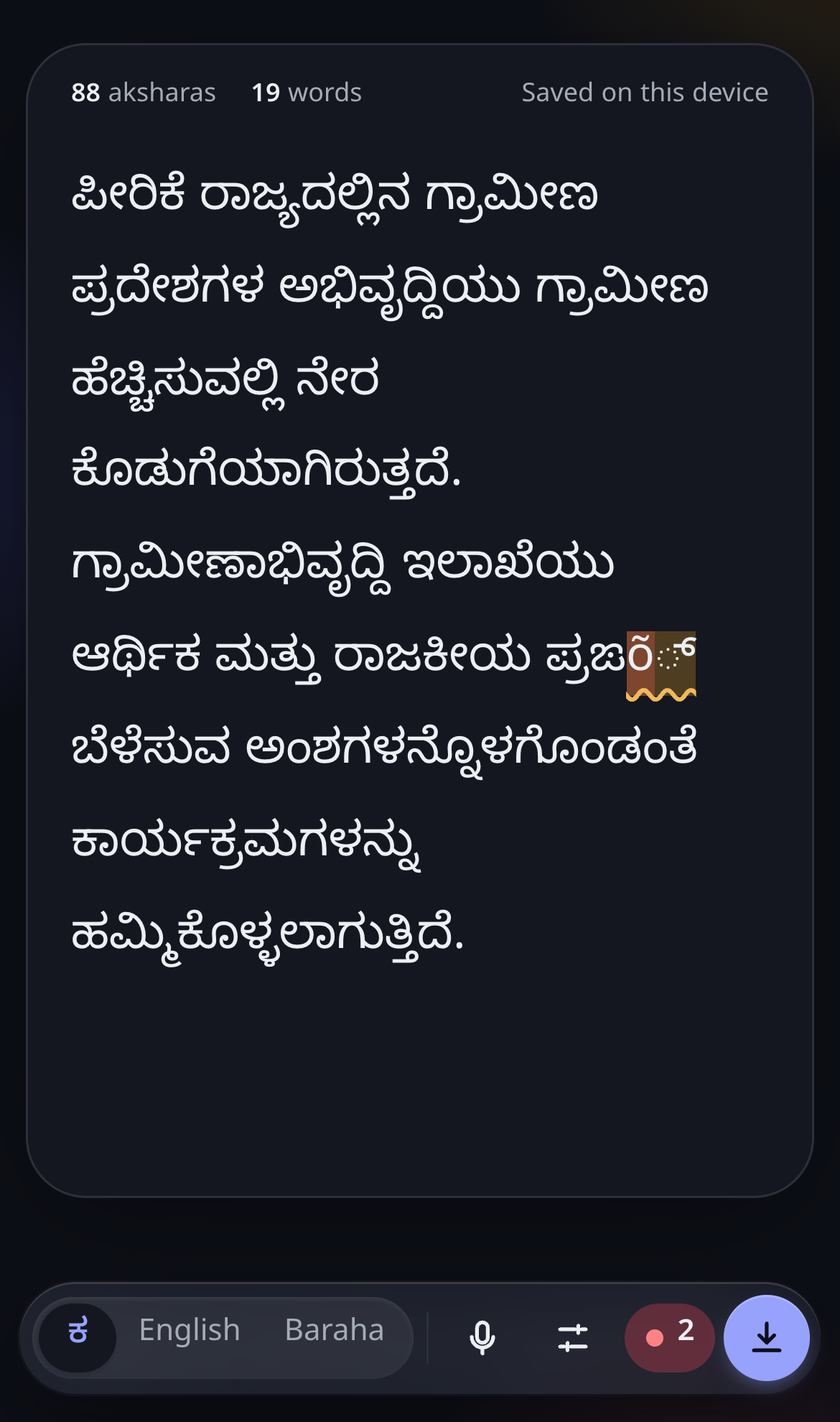
The editor runs on the visitor's device with WebAssembly. Files are not uploaded, and the site has no cookies and no analytics. Editor